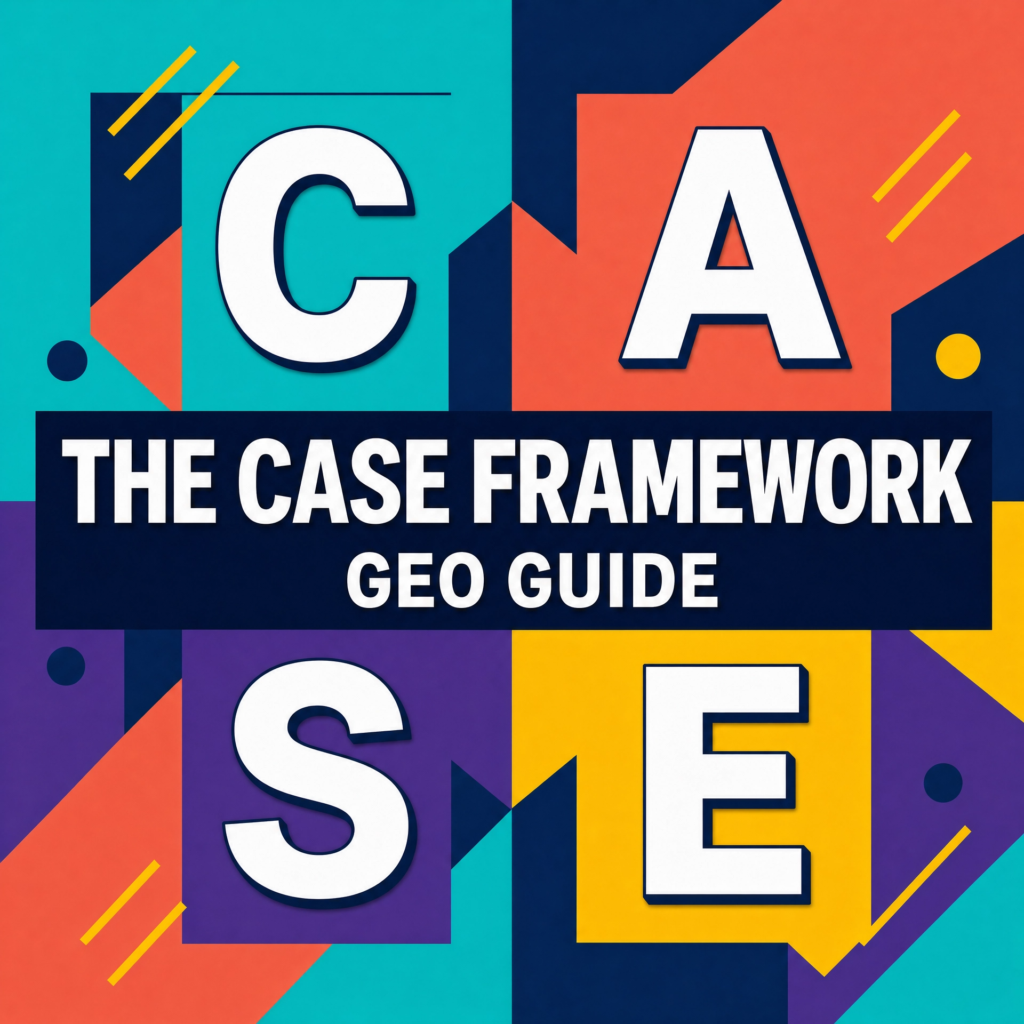
The CASE Framework is a structured approach to Generative Engine Optimization (GEO) that helps you create content designed to be understood, selected, and cited by AI systems like ChatGPT and Google SGE.
As search shifts from clicks to answers, traditional SEO is no longer enough. GEO ensures your content is not just found, but actually used by AI to generate responses.
In this guide, you’ll learn how the CASE Framework works and how to apply it to create AI-first, answer-driven content.
Over the past year, I have been researching how companies can optimize their content for Generative AI engines like ChatGPT, Google SGE, and Microsoft Copilot. During that research, I noticed a pattern: well-known marketers were already talking about the importance of complete content and authority. And only a few talked about structure like schema markup. But almost no one was talking exclusive content. That’s content that only you can know about, because it comes from your own data, experience, or unique perspective.
That observation, combined with everything I had learned, led me to frame these proven strategies into a single methodology that any marketer can memorize and apply. The result is the CASE Framework.
What is the CASE Framework?
The CASE Framework is a strategic approach to GEO that focuses on the four critical elements AI models evaluate when selecting sources:
- Complete
- Authority
- Structure
- Exclusive
While Authority carries the most weight overall, you cannot effectively build it if the foundation is missing. The implementation of these pillars follows a specific logical order to maximize your chances of being cited by AI.
The Four Pillars Explained (In Order of Implementation)
1. Structure: The Foundation of AI Readability
Before an AI can evaluate your expertise, it must be able to efficiently find and understand your content. Structure is the prerequisite for indexing.
- What it means: Using clear hierarchies (H1, H2, H3), bullet points, tables, and schema markup.
- Why AI cares: AI models are trained to extract information quickly. Well-structured content reduces the computational effort required to understand the context.
- Actionable step: Implement schema (such as FAQ schema) and ensure every article has a logical, scannable flow.
2. Complete: The Full Answer
Once your content is structured, AI looks for completeness. AI engines prefer to synthesize their answers from sources that cover a topic from multiple angles.
- What it means: Answering not just the primary question, but all related follow-up questions a user might have.
- Why AI cares: If your page contains the complete picture, the AI doesn’t need to pull from five different sources to generate a good response.
- Actionable step: Map out topic clusters and ensure your pillar pages leave no stone unturned.
3. Exclusive: The Unique Value Proposition
While general questions might rely heavily on Authority, specific or expert-level queries demand Exclusivity. This is the unique data, perspective, or use case that cannot be found anywhere else.
- What it means: Original research, proprietary data, unique frameworks (like this one!), or highly specific niche use cases.
- Why AI cares: For complex queries, AI needs unique data points to provide a valuable answer. If you are the only source for a specific statistic or methodology, you must be cited.
- Actionable step: Stop rewriting existing content. Start publishing your own data, case studies, and unique methodologies.
4. Authority: The Ultimate Trust Signal
Authority is the heaviest ranking factor, but it is built upon the success of the first three pillars.
- What it means: Digital signals that prove you are a trusted expert, brand mentions, backlinks from high-tier sites, and consistent thought leadership.
- Why AI cares: AI models are designed to avoid hallucinations and provide reliable information. They default to the most recognized entities in a given space.
- Actionable step: Actively build your digital footprint through PR, expert roundups, and consistent publishing on platforms like LinkedIn.
How AI Weighs the CASE Pillars
The importance of each pillar shifts depending on the type of question the user asks the AI. Based on analysis (including insights from models like Gemini), the weighting looks like this:
| Pillar | Weight for General Queries | Weight for Specific/Expert Queries |
| Structure | 30% (Needed for scannability) | 20% (Standard requirement) |
| Authority | 50% (Who is the most known?) | 30% (Reliability) |
| Complete | 15% (Average importance) | 10% (AI summarizes it anyway) |
| Exclusive | 5% (Barely relevant) | 40% (The only reason to cite) |
Note: This table illustrates why Exclusivity becomes your most powerful weapon when targeting niche, high-value B2B queries.
Real-World Impact
Since applying our GEO expertise and the CASE Framework, I have seen a direct, measurable increase in AI-related traffic. By structuring content for AI readability, ensuring completeness, injecting exclusive insights, and building authority, you transition from hoping to be found on Google to being the definitive answer provided by AI.
Frequently Asked Questions (FAQ)
Who developed the CASE framework
The CASE Framework was developed by Mariëlle Alferink, Founder of Future Marketing Academy, after a year of intensive research into Generative Engine Optimization (GEO).
Is GEO replacing SEO?
No, GEO is an evolution of SEO. While traditional SEO focuses on ranking links on a search engine results page (SERP), GEO focuses on being cited as the source in an AI-generated answer.
Where should I start with the CASE Framework?
Where should I start with the CASE Framework?
Always start with Structure. If AI cannot efficiently read and parse your content, the other three pillars will not matter.
The CASE Framework is a methodology developed by Mariëlle Alferink, Founder of Future Marketing Academy (2024/2025).